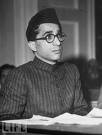
Mian Iftikharuddin (8 April 1907 – 6 June 1962) was the last Nazim of Shalimar garden from this family till 1962. Born into the wealthy and influential Arain Mian family of Baghbanpura, Lahore—the custodians of the iconic Shalimar Gardens—he grew up in privilege.
His father, Khan Bahadur Mian Jamaluddin, was the owner of over 1200 acres of land in various parts of Lahore district and served as an honorary magistrate and a zaildar. Jamaluddin was also the holder of the keys to the main gate of Shalimar Gardens, which upon his death were passed on to his only son, Mian Iftikharuddin.
Iftikharuddin completed his initial schooling at the elite Aitchison College in Lahore before moving to England, where he read Philosophy, Politics, and Economics (PPE) at Balliol College, Oxford. His education heavily influenced his lifelong commitment to socialist and democratic principles.
Unlike rest of the family he was initially considered leftist leader. He started his political career as member of India Congress Party and He remained president of the Punjab provincial Congress till 1945. He struggled a lot to develop common grounds for Indian Congress and Muslim League but eventually resigned for non-corporation from Congress leadership. Later he joined All India Muslim League on personal requests of Mohammed Ali Jinnah.
After creation of Pakistan in 1947, Jinnah appointed him as ‘Minister In-Charge for rehabilitation of refugees’. He proposed that the only way for the successful rehabilitation of all those people who had flooded into what was now Pakistan in the aftermath of Partition was to implement land reforms. These would require the breaking up of large estates. He was of the view that refugees should be allotted evacuee property according to their needs and not based on how much land they had left behind. To him, the idea of continuation and reproduction of social inequality, by making a rich refugee rich in Pakistan and a keeping a poor refugee poor was unfair. Dominated by feudal landowners, and a Chief Minister who was himself a big refugee landlord, the Government rejected his proposal altogether. Dejected by the centre’s unwillingness to support such a move, Mian Iftikharuddin voluntarily resigned from the post saying that if majority of house is not convinced, he has no right to hold ministry.
“I want to ask the Finance Minister what prevents him in this state of crisis when 98% of the total income of our state is being spent on defence, what prevents him I ask the Finance Minister, to take over the land of all landowners owning above 50 acres”
– Mian Iftikharuddin | Speech in The Constituent Assembly of Pakistan – March 18, 1950
Just after freedom, Jinnah was of the view that there was not a single newspaper that could represent the viewpoint of the Muslim League during this time. Therefore, in May 1946, Progressive Papers Ltd. (PPL) was set up by Mian Iftikharuddin. The PPL started publishing the newspaper Pakistan Times, with distinguished poet Faiz Ahmed Faiz as its editor editor. Founded under Jinnah’s patronage, the Pakistan Times was received enthusiastically and played a great role in founding early journalism in country. Later, PPL also published the famous Imroze newspaper in Urdu, the editors of which were literary lights such as like Ahmed Nadeem Qasmi and Chiragh Hasan Hasrat, and the progressive weekly Lail-o-Nihar in 1957, of which the famous scholar Syed Sibt-e-Hasan was the editor. When Ayub Khan imposed first martial law in country, both newspapers openly opposed this decision.
Mian Iftikharruddin had an opinion that such success of undemocratic action would open a door for many martial-laws in future. Time has proved how correct he was!
He supported Fatimah Jinnah in 1960’s election which she lost as per official results. In result both newspapers and property of Mian Iftikharruddin nationalized by martial-law government. Family lost custodianship of Shalimar Gardens during same struggle.
Later Mian Iftikharuddin formed his own Azad Pakistan Party and was considered a leading light of the National Awami Party as well in struggle to establish true democratic party in Pakistan having true representation from all across the nation, but unfortunately all attempts got vein and soon party was over taken by other elements.
Faiz Ahmed Faiz, Mian Iftikharuddin’s friend and ally, wrote one of his most haunting poems as a tribute to the man:
Na ganwao nawak-e-neem kush
Dil-e-reyza reyza ganwaa diya
Jo bachay hein sang samet lo
Tan-e-Daagh daagh lutaa Diya Kar Hazra
Jo rukey tau koh-e-giraa thhay hum
Jo chalay tau jaan se guzar gaye
Rah-e-yaar hum ne qadam qadam
Tujhe yaadgaar banaa diya
He died heartbroken on June 6, 1962.
Following Mian Iftikharuddin’s death in June 1962, the military regime of Field Marshal Ayub Khan instructed the West Pakistan Auqaf Department to seize control of the historic property. Government officials took physical possession of the keys to the main gate from Mian Iftikharuddin’s family, ending more than 350 years of hereditary custodianship by the Mian family of Baghbanpura.
References:
- https://criterion-quarterly.com/mian-iftikharuddin/
- The Daily Dawn, December 8, 2012, “Remembering Mian Iftikharuddin“,
http://www.dawn.com/news/769764/remembering-mian-iftikharuddin - Weekly Friday Times, February 2011, “Democracy’s Martyr: Mian Iftikharuddin“
- “Mian Iftikharuddin: A Keeper of the Nation’s Conscience” by A.G. Noorani, June 18, 2023
- Daily Nawa-e-Waqt, August 15, 2023; “میاں افتخار الدین اور متروکہ جائیداد”
- Speech of Mian Iftikharuddin in the Constituent Assembly – 10 March 1949
- Speech in The Constituent Assembly of Pakistan – March 18, 1950
Be First to Comment