Sir Mian Muhammad Shafi (1869–1932) was an indispensable architect of Muslim political, legal, and educational advancement in British India. Emerging from the prominent Arain Mian family of Baghbanpura, Lahore, Shafi rose to become one of the subcontinent’s most formidable legal minds and states people. His pragmatic, constitutional approach firmly established the institutional safeguards that later paved the way for the creation of Pakistan.
Born on 10 March 1869 in Lahore, Mian Muhammad Shafi belonged to the aristocratic Arain Mian family of Baghbanpura. His family possessed great wealth and considerable influence, serving as the historical hereditary custodians of the iconic Shalimar Gardens by decree of Mughal Emperor Shah Jahan.
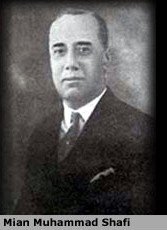
Shafi’s early education began in his village Middle School before he moved to Lahore’s Central Model School. He pursued higher education at Government College Lahore and Forman Christian College. Showing immense intellectual promise, he traveled to London in 1889 to study law at the Middle Temple. While in England, he immersed himself in British political culture, joining esteemed political networks like the Paddington Parliament and serving as the President of the London branch of the Anjuman-i-Islamia.
Upon returning to India as a certified barrister in 1892, Shafi initially established his legal practice in Hoshiarpur before moving permanently to Lahore. He quickly established a brilliant reputation at both the Lahore and Allahabad High Courts, eventually becoming recognized as one of British India’s premier legal minds.
When the Punjab Land Alienation Act of 1900 excluded the Arain community from buying land or receiving grants in the Canal Colonies, Sir Mian Muhammad Shafi and Justice Mian Shah Din fought the British administration. Their landmark legal victory got the Arains officially gazetted as a protected Agricultural Tribe. This allowed hundreds of thousands of Arains to acquire land, building the economic foundation that propelled the community into higher education, politics, and the state bureaucracy.
Shafi’s standing in public life grew alongside his political activity. In 1916, he was appointed a Companion of the Order of the Indian Empire (CIE), and in 1917 he was elected president of the Punjab Chief Court Bar Association, according to the supplied material. These appointments reflected his reputation within the legal profession and his increasing prominence in Punjab.
In July 1919, he joined the Viceroy’s Executive Council, entering the central administration of British India at a time of considerable political and administrative change. His responsibilities included education and health, and he later also held responsibilities for law.
Shafi’s political worldview was profoundly shaped by the educational renaissance started by Sir Syed Ahmed Khan and the Aligarh Movement. Shafi became a lifelong standard-bearer of Sir Syed’s philosophy in Punjab. While serving as the Education Member on the Viceroy’s Executive Council (1919–1924), Shafi turned Sir Syed’s ultimate dream into institutional reality. He spearheaded the critical imperial legislation in 1920 that officially upgraded the Muhammadan Anglo-Oriental College into the historic Aligarh Muslim University (AMU), alongside establishing the University of Delhi.
In early 1906, Shafi took matters into his own hands by organizing a Muslim Association in Punjab to provide a unified political voice for the region’s Muslims. Later that year, in October 1906, he served as a key member of the historic Simla Deputation, where Muslim leaders met with Viceroy Lord Minto to formally demand separate electorates.
This momentum culminated on 30 December 1906 in Dacca (Dhaka) during the annual All-India Muhammadan Educational Conference. Shafi was one of the primary founders of the All-India Muslim League (AIML). In fact, it was Shafi who formally suggested the party’s official name during the conference. Upon returning to Lahore, he merged his pre-existing Muslim Association into the newly created structure, establishing the highly powerful Punjab Provincial Muslim League in 1907, serving as its long-term General Secretary.
Sir Mian Muhammad Shafi strongly advocated separate electorates and strong provincial autonomy, a stance that culminated in a late-1920s rift over the Simon Commission. While Jinnah boycotted the commission, Shafi favored cooperation to secure Muslim rights, temporarily splitting the party into the “Jinnah League” and the “Shafi League.” Backed by most founding leaders—including Allama Iqbal as his Secretary General—Shafi maintained massive clout but worked diligently to reunify the factions back to All India Muslim Leage, shortly after the commission left.
During the global crisis of the Khilafat Movement (1919–1924), when Allied powers sought to dismantle the Ottoman Empire after WWI, Shafi played a critical diplomatic role from inside the colonial government. As a member of the Viceroy’s Council, Shafi served as a direct pipeline between grieving Indian Muslims and the British Crown. He continually warned the Viceroy and the Crown that the harsh terms of the initial Treaty of Sèvres (1920) to dismantle Ottoman Empire and Muslim Khilafat would trigger an uncontrollable rebellion across India. This internal pressure from Shafi and other moderate leaders forced the British to reconsider, eventually leading to the Treaty of Lausanne (1923), which successfully preserved and recognized the sovereignty of modern-day Turkey today.
In his final years, Shafi served as the Deputy Leader of the British Indian Muslim delegation at the Round Table Conferences (1930–1932) in London. Alongside Jinnah and the Aga Khan, Shafi championed a decentralized federal system with absolute provincial autonomy, ensuring Muslim-majority provinces like Punjab and Bengal could govern themselves. His daughter, Begum Jahanara Shahnawaz, walked in his footsteps at the conferences as a pioneering female delegate.
Sir Mian Muhammad Shafi’s legacy is defined by his masterful use of constitutional, legal, and diplomatic channels. Whether securing land rights for the Arain community, chartering universities, protecting Turkish sovereignty, or fighting for separate electorates alongside Allama Iqbal, Shafi spent his life building the structural foundations of Muslim political identity. When he passed away in 1932, he left behind a highly organized, legally protected Muslim polity ready to realize the dream of an independent homeland.
References:
1. “A Dictionary of Modern Indian History (1707-1947)” by Parshotam Mehra
2. “The Woking Muslim Mission, England, 1913-1960s: Sir Muhammad Shafi.” Woking Muslim Mission Archives.
3. Shah, S. A. H., Khan, A. Z., & Ashraf, Z. “Sir Mohammad Shafi and Muslim Separatism in British India: An Analysis.” Asian Journal of International Peace and Security (AJIPS), Vol. 5, 2021.
4. Shah, S. A. H. “Sir Muhammad Shafi & Mainstream Muslim Politics, 1928-1932.” Journal of Punjab University Historical Society, Vol. 23, No. 1, 2010.
5. S.M. Ikram, Modern Muslim India and the Birth of Pakistan, Lahore, 1997
6. “Mian Muhammad Shafi: A Forgotten Hero of the Aligarh Movement”, The Heritage Times.
7. “تاریخ آرائیاں” (Tareekh-e-Araina) by Asghar Ali, 1964
8. ‘Qanoon Daan Iqbal’ by Zafar Ali Raja
Be First to Comment